
The phrase “embedded marketing team” gets used loosely. Agencies apply it to retainers. Freelancers use it to mean availability. Product companies use it to mean a marketer inside a product squad.
None of these are wrong. But they describe different team structures with different implications for how work gets done, who owns the outcome, and what you can actually expect from the relationship.
If you are deciding how to structure your product marketing function, or working out if a sprint-based model fits your growth stage, this post draws the line clearly.
What does ’embedded’ actually mean?
The word “embedded” describes how people work, not where they sit.
A marketer working to that definition is not simply assigned to a client or squad on a contract. They operate inside the context: the sprint, the data, and the accountability for what comes next. The message stays consistent because the team never loses the thread between what the product does and what marketing says about it. That is the defining characteristic: shared context as a default, not an exception.
In product-led companies, marketers embedded in specific squads contribute directly to planning decisions, own go-to-market execution for their squad, and work closely with product and engineering. Not briefed at the end of a sprint. Present during it. This is what “embedded within” a product team actually means operationally.
In the agency world, the term describes a relationship where an external team operates with the context, cadence, and commercial ownership of an internal hire: shared OKRs, sprint access, accountability for revenue outcomes rather than deliverables.
Three conditions have to hold:
- Shared context: they know your customers, your data, and your past decisions
- Sprint cadence: work moves in structured cycles, not by request
- Result ownership: measured on numbers, not tasks
If a relationship is missing any of these, it is a retainer, a project, or a managed service: not the model you are looking for.
How to structure a product marketing team: centralized, decentralized, or hybrid
For product companies, the question is not if you need product marketing: it is how to structure it. Product marketing teams typically face three structural choices, and this is where most debates happen.
Centralized product marketing pools all product marketers in a shared function. Strong marketing leadership maintains consistent positioning across the portfolio, shared tooling, and a single measurement function. The tradeoff: squads queue for support. As product development accelerates, the central function becomes a bottleneck. Priorities conflict. Speed suffers.
Decentralized structure places specialists directly inside specific product teams. Each squad gets a dedicated specialist who contributes to sprint planning, owns product positioning, and helps connect product decisions to customer go-to-market execution. Speed improves considerably. The tradeoff: brand consistency and the broader marketing mix require active governance, and the central marketing function can fragment without strong central coordination.
Hybrid structure is where most mature companies settle. Core marketing (brand standards, content team direction, workflow strategy) stays centralized. Execution-level specialists sit inside specific product squads at sprint pace. You get the consistency of a centralized function with the velocity of squad-level execution. This is also where strategic direction is clearest: central ownership, distributed execution.
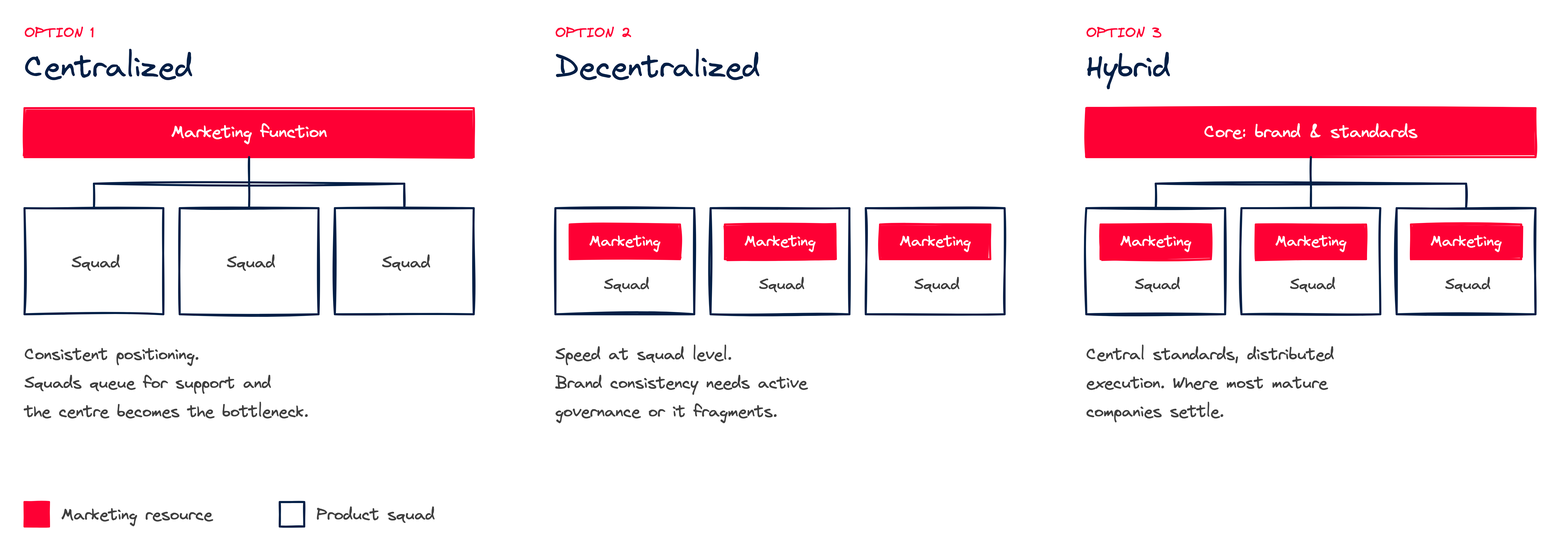
Three ways to structure the function. Red marks where the marketing resource sits.
To build out product marketing effectively, start with the product roadmap. Identify the squads where go-to-market timing is most critical. Place dedicated marketing resource there first. Pull from centralized capability for everything that does not need that proximity to the product cycle.
The right structure depends on where the bottleneck actually is, not on what the org chart looks like at companies three times your size. Structure your product marketing team around that reality. For earlier-stage companies: one senior product marketer in the founding team, owning the go-to-market brief and product strategy, is worth more than a full centralized function you are not ready to use.
How embedded teams help: analytics, automation, and scaling
Sprint-based teams help businesses grow without the cost of building a full internal capability from scratch, but what they deliver depends entirely on how the engagement is set up.
The analytics advantage is significant. When the team shares your data environment directly, they respond to what the numbers show in-sprint rather than in the next monthly report. The analytics team is not reviewing a deck. They are inside the data as it moves. When a marketing campaign underperforms on Thursday, the next iteration runs on Friday.
Automation becomes substantially more effective when the team has direct access to your systems and pipeline context. They build and iterate against real data, not a brief written three weeks ago. Marketing efforts connect to revenue because the team can see the full chain from campaign to pipeline to close. Seamless revenue handoffs between functions become achievable rather than aspirational.
What a sprint-based team typically delivers:
- Real-time optimisation: decisions made inside the sprint, not at the monthly review
- Content aligned to your product: informed by what the team is actually building
- Measurable marketing ROI: accountability for metrics, not activity reports
- Launch execution at product speed: go-to-market moves in the same cadence as the product cycle
- Scalable workflows: built and iterated with full systems access
The pain points it addresses: slow marketing campaigns, content that does not connect to revenue, and the drag of briefing external teams on context they never fully absorb.
Digivate ran as the full sprint-based team for Neocase, a B2B SaaS platform. Six months, applied across paid and organic: 102% more leads, 3.4% conversion rate (four times the industry average). Drive growth at that rate requires marketing inside the sprint, not downstream of it.
In-house, agency, or embedded: marketing models worth knowing
Most businesses arrive at this question after cycling through the alternatives: hire in, outsource, or find something between the two.
In-house marketing gives you maximum context and alignment. Your internal team knows the business, the customers, and the culture. The tradeoff: hiring, retaining, and maintaining a high-quality marketing function is expensive and slow. For technology companies and professional services firms at growth stage, building the team before you can fully use it is a costly mistake. This model delivers the highest context, at the highest fixed cost.
The traditional agency model (an external team working against a brief) offers specialist skills and digital marketing capacity without the hiring overhead. The tradeoff is context. The agency works closely on your campaigns but operates outside your business. Revenue alignment requires deliberate effort. Collaboration with sales teams happens in presentations, not standup. Traditional marketing relationships are built around delivery, not shared accountability. You get a marketing partner that delivers the brief, not one invested in your success the way an internal hire is.
The embedded model closes the gap. You get specialist capability and capacity, operating with the context and outcome-ownership of an internal hire, without the overhead of building one from scratch. For account-based marketing programmes, companies with long sales cycles, or businesses that need tight marketing and sales teams integration, it delivers what a traditional agency cannot.
The practical comparison:
- In-house teams: high context, outcome-based accountability, low flexibility
- External agency: low context, deliverable-based accountability, medium flexibility
- Embedded: high context, outcome-based accountability, high flexibility
The sprint-based team is an extension of your business, not a supplier relationship. That is what distinguishes it: a genuine partnership, not a contract renewal.
Is the embedded model right for your business? Small businesses to enterprise
Not every business is at the right stage for this model.
Smaller operations with limited and inconsistent marketing activity are usually better served by a marketing specialist on a focused brief. The structure this engagement requires (shared data access, OKR alignment, sprint reviews) is not justified without consistent activity to build around.
Scaling companies (post-product-market-fit, heading toward 50–200 people) are the natural fit. You need reliable marketing execution without the cost of building marketing organizations from scratch. You need business solutions that connect directly to business goals. You need an external function that runs with business growth urgency, not supplier delivery cycles. You can scale without the cost of a full permanent function: that is exactly what a sprint-based team is designed for. That capital goes to growth instead.
Enterprise businesses use the model differently: filling specific capability gaps, running internal marketing programmes at pace, or bringing specialist skills into areas where permanent marketing headcount is not the right answer.
Three questions to test readiness:
- Can you give an external team meaningful access to your data, product context, and commercial targets?
- Is your challenge about execution capacity, or about the clarity of your marketing strategy?
- Is reliable marketing a growth driver at your current stage, or still a future priority?
If yes to all three, the embedded model is worth exploring seriously. If not (particularly on the first question), a more structured traditional engagement will serve you better until the business is ready for it.
How Digivate runs this in practice
Digivate’s approach runs on F.L.O.W.S., a sprint-based operating framework:
- Find the friction: audit and assess what is holding growth back
- Level the foundation: fix structural issues before growth
- Organise opportunities: map activity to commercial goals
- Work in sprints: 2-week execution cycles, not monthly plans
- Sharpen through insights: iterate on what the data shows
Content marketing, paid media, SEO, and performance tracking move together inside your commercial cycle. Every two weeks: a clear output, a clear result, a clear decision about what runs next.
If marketing is the thing holding your growth back, we can audit what you are running now and tell you where a sprint-based team would help, and where it would not. Get in touch.
- Digital Marketing
Gledsley Müller
Gledsley Müller is the owner of Digivate Group, with agencies across three continents. He has worked in science labs, agencies, startups and corporate teams. He now uses that experience to train and coach business owners, and his own people, in Sales, Marketing, Business, and AI & Automations.
YOUR RECOMMENDED Blog
More insights to fuel your growth
Dive deeper into strategies that transform businesses
What’s holding your growth back?
In under 5 minutes, you’ll get a custom scorecard on where your digital marketing stands - and what to fix next.